Frequently Asked Questions
This page collects questions that arise most frequently among home baristas working through the experiments and reference material on this site. Where a question is better addressed by an in-depth page elsewhere, a link is provided rather than a condensed (and potentially misleading) summary.
Questions About Milk and Steaming
Why does whole milk produce more stable microfoam than skim milk?
The short answer is fat content. Fat globules in whole milk (typically around 3.25 % by weight) act as structural reinforcements within the foam matrix, slowing the rate at which bubbles coalesce and drain. Skim milk can produce voluminous foam — sometimes more of it — but the bubbles tend to be less uniform and the foam degrades faster (often within 15–20 seconds under observation). The surfactant proteins (primarily caseins and whey proteins) are present in both, but fat provides a secondary stabilisation mechanism that skim milk lacks. A more detailed comparison, including oat and soy alternatives, is covered on the Milk Type Experiments page.
What temperature should I aim for when steaming?
Most of the observable tests on this site use a target range of 55–65 °C (measured with an instant-read thermometer inserted after the steam wand is removed). Below roughly 55 °C, the milk tends to taste under-sweetened and the foam can be loose; above about 68 °C, lactose browning accelerates and the surfactant proteins begin to denature in ways that collapse microfoam structure. The result is a noticeably thinner texture and a muted sweetness. The Temperature & Steam Pressure Tests page walks through controlled comparisons at 5 °C increments.
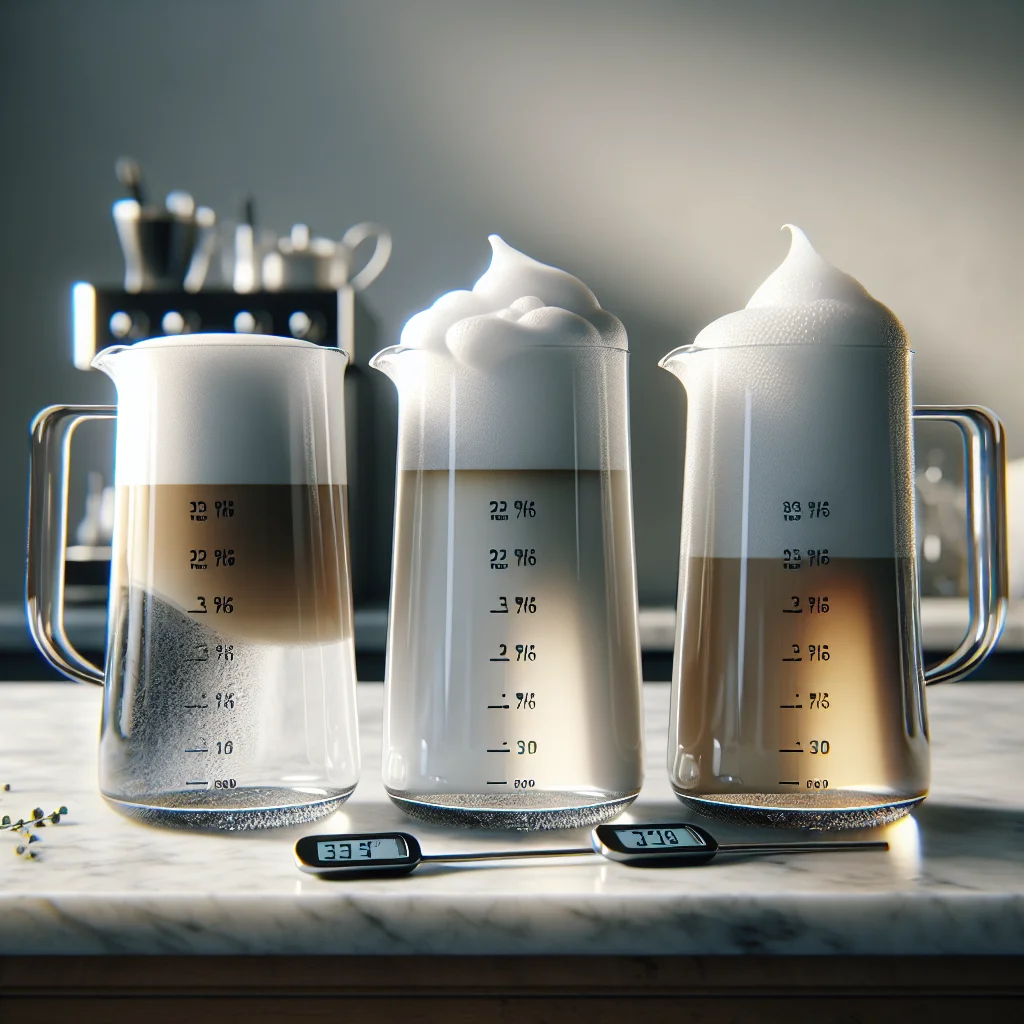
Does the type of steam tip matter?
It does, though perhaps less dramatically than pitcher technique. A two-hole tip tends to produce a tighter vortex at lower pressures, while a four-hole tip introduces air more rapidly (which can be an advantage or a liability, depending on flow rate and the operator’s timing). Equipment specifics are catalogued on the Equipment & Tools Reference page.
Questions About Pouring and Pattern Definition
How much does pour height actually affect the result?
Measurably. When the spout is held 8–10 cm above the surface of the drink, the stream has enough momentum to sink beneath the crema, producing a blank canvas. When lowered to roughly 1–2 cm, the milk rides on top, depositing the white contrast lines that form a pattern. The transition between these two phases — sometimes called the “push and paint” shift — is the single variable that explains most beginner difficulties. The Pouring Technique Variables page isolates height, flow rate, and pitcher angle in separate trials.
Why do my patterns disappear within seconds?
Two common causes: first, the espresso base may have thin or rapidly degrading crema (often the case with stale beans or under-extracted shots), which provides insufficient contrast and structural support. The Espresso Base & Crema Analysis page examines this in detail. Second, the microfoam itself may be too aerated — large, visible bubbles rise and pop, taking the pattern with them. A brief “polish” swirl of the pitcher after steaming, followed by a firm tap on the counter, helps collapse the largest bubbles before pouring.
Questions About the Experiments Themselves
Do I need special equipment to replicate these tests?
Not especially. A capable home espresso machine with a steam wand, a stainless-steel pitcher, an instant-read thermometer, and a kitchen scale cover the vast majority of trials. A phone camera set to consistent lighting is sufficient for visual documentation. The Beginner’s Guide outlines a minimal setup and a first experiment to try.
How many repetitions make a test meaningful?
These are observational home experiments, not peer-reviewed studies, so statistical rigour has practical limits. That said, repeating each condition at least three to five times — and photographing every attempt — tends to reveal consistent trends while filtering out single-pour anomalies.
Most of the topics touched on above are explored at greater length in the individual experiment pages and the Glossary. For a structured starting point that ties these concepts together, the Beginner’s Guide to Experiment-Based Latte Art is a reasonable place to begin.