Temperature & Steam Pressure Tests
Milk temperature and steam pressure are two of the most consequential variables in latte art, yet they are often treated as a single, blurred step: “steam the milk until it’s hot.” In practice, these are independent parameters with distinct effects on microfoam texture, perceived sweetness, and the barista’s ability to control contrast during a pour. The experiments described here attempt to isolate each variable and observe the outcomes under repeatable conditions.
How Temperature Affects Microfoam and Sweetness
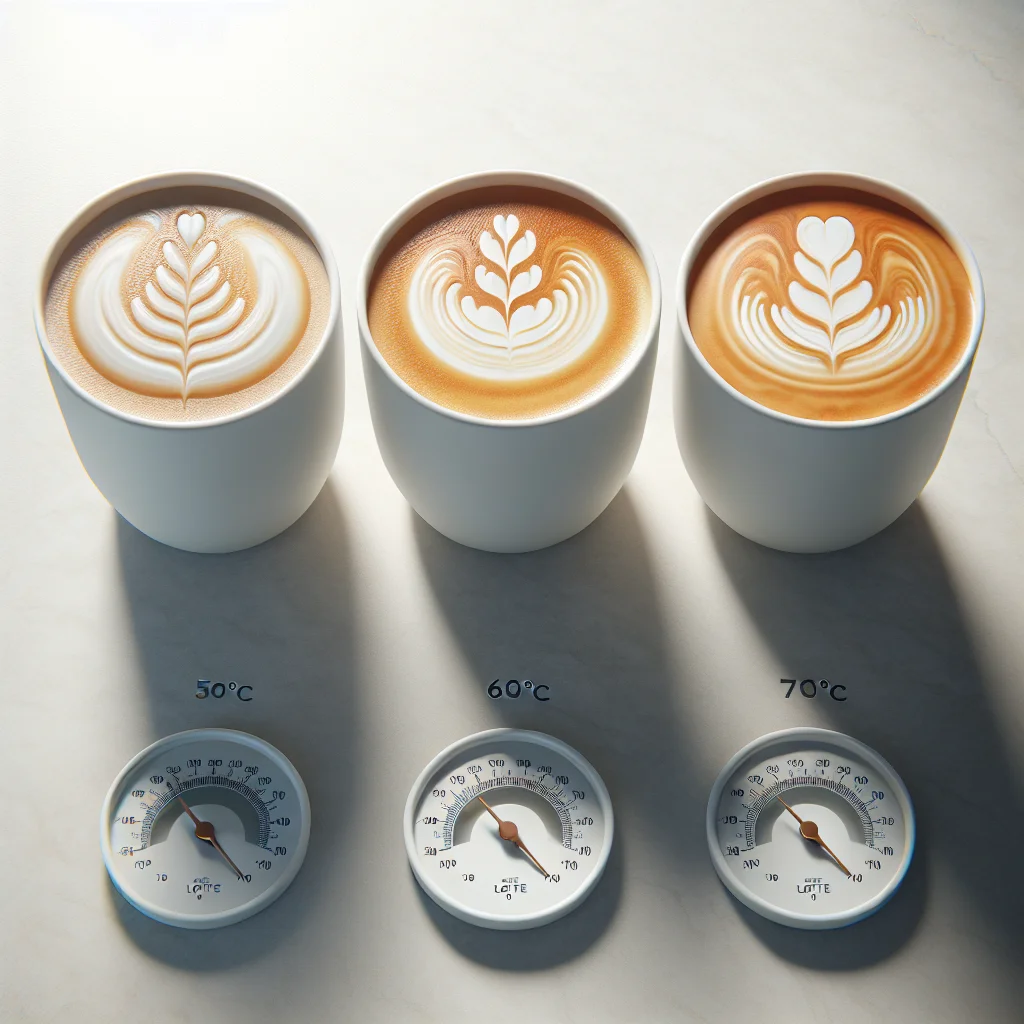
The central hypothesis is straightforward: milk steamed to different final temperatures will produce measurably different foam densities and noticeably different flavour profiles. To test this, whole milk (3.5 % fat, refrigerated to approximately 4 °C) was steamed in identical 350 ml pitchers to three target temperatures — 50 °C, 60 °C, and 70 °C (all measured with an instant-read thermometer inserted at the centre of the pitcher, away from the wall). Steam pressure was held constant at roughly 1.2 bar at the boiler, using the same single-hole tip throughout.
The results were consistent across repeated trials:
- 50 °C — The milk retained a notably sweet taste (lactose conversion to sweeter-tasting glucose and galactose peaks when the enzyme lactase is most active, roughly in the 40–55 °C range). However, the microfoam was somewhat loose and separated quickly, making it difficult to hold definition during pours. Rosetta leaves tended to blur within seconds.
- 60 °C — This range produced what could be described as the most balanced outcome: a perceptible sweetness, a dense and glossy microfoam with small, uniform bubbles, and reliable paint-like consistency during pouring. Contrast between white foam and espresso crema remained sharp for the longest period.
- 70 °C — Sweetness diminished markedly (likely due to Maillard reactions and protein denaturation above 68 °C reducing the availability of simple sugars). The foam was tighter but also stiffer, behaving less like a fluid and more like a meringue. Fine details in free-pour patterns became harder to achieve because the milk did not flow smoothly from the pitcher spout.
The result suggests that a final temperature in the 55–65 °C window offers the best compromise between flavour and foam workability (at least for whole cow’s milk — results for plant-based alternatives are documented on the milk type experiments page).
Steam Pressure and Bubble Structure
Adjusting steam pressure changes the rate at which air is incorporated and the shear forces that break large bubbles into smaller ones. On machines with an adjustable steam knob (or a PID-controlled boiler where pressure can be set), reducing pressure from roughly 1.5 bar to 0.8 bar produced a visibly different foam character, even when final temperature was kept at 60 °C.
- Higher pressure (~1.4–1.5 bar) — Air was incorporated very quickly, requiring precise timing to avoid over-aerating. When executed well, the high shear forces produced extremely fine, dense microfoam. When executed poorly (even a half-second too long in the stretching phase), the result was a dry, stiff cap sitting on top of thin liquid.
- Lower pressure (~0.8–1.0 bar) — The slower introduction of air offered a wider margin for error. Foam texture was good but slightly less dense, with marginally larger average bubble diameter (observable under a magnifying loupe, roughly 0.3–0.5 mm versus sub-0.2 mm at higher pressure).
For those still developing consistency, operating at moderate pressure (around 1.0–1.2 bar) appears to offer the most forgiving window for producing pour-quality microfoam.
A Note on Equipment Variability
Home espresso machines vary widely in boiler capacity, steam tip design, and pressure stability. A machine with a small thermoblock will lose pressure more rapidly during steaming than a heat-exchange or dual-boiler unit, which means the “effective” pressure at the tip drops as steaming progresses. This is worth bearing in mind when attempting to replicate any pressure-specific finding — the equipment and tools reference page discusses common machine types and their steam characteristics in more detail.
Summary
Temperature and steam pressure each exert independent, observable effects on foam quality and latte art definition. A final milk temperature near 60 °C and a moderate, stable steam pressure around 1.0–1.2 bar produced the most consistently pourable microfoam in these tests. These findings pair well with the pouring variables explored on the pouring technique page and the crema behaviour documented on the espresso base and crema analysis page. For definitions of terms like microfoam density, stretching phase, and Maillard reaction, the glossary provides concise explanations.