Espresso Base & Crema Analysis
The espresso shot beneath a latte art pour functions less as a flavour vehicle (though it is that, too) and more as a canvas — a surface whose colour, viscosity, and crema density determine how cleanly milk patterns resolve. The experiments below isolate three variables that alter that canvas: dose, grind size, and the resulting crema characteristics. Each test was repeated five times under otherwise identical conditions (same water temperature at 93 °C, same tamping pressure estimated at roughly 15 kg, same 18 g VST basket) to reduce noise.
Dose and Grind Size: Effects on Crema Thickness
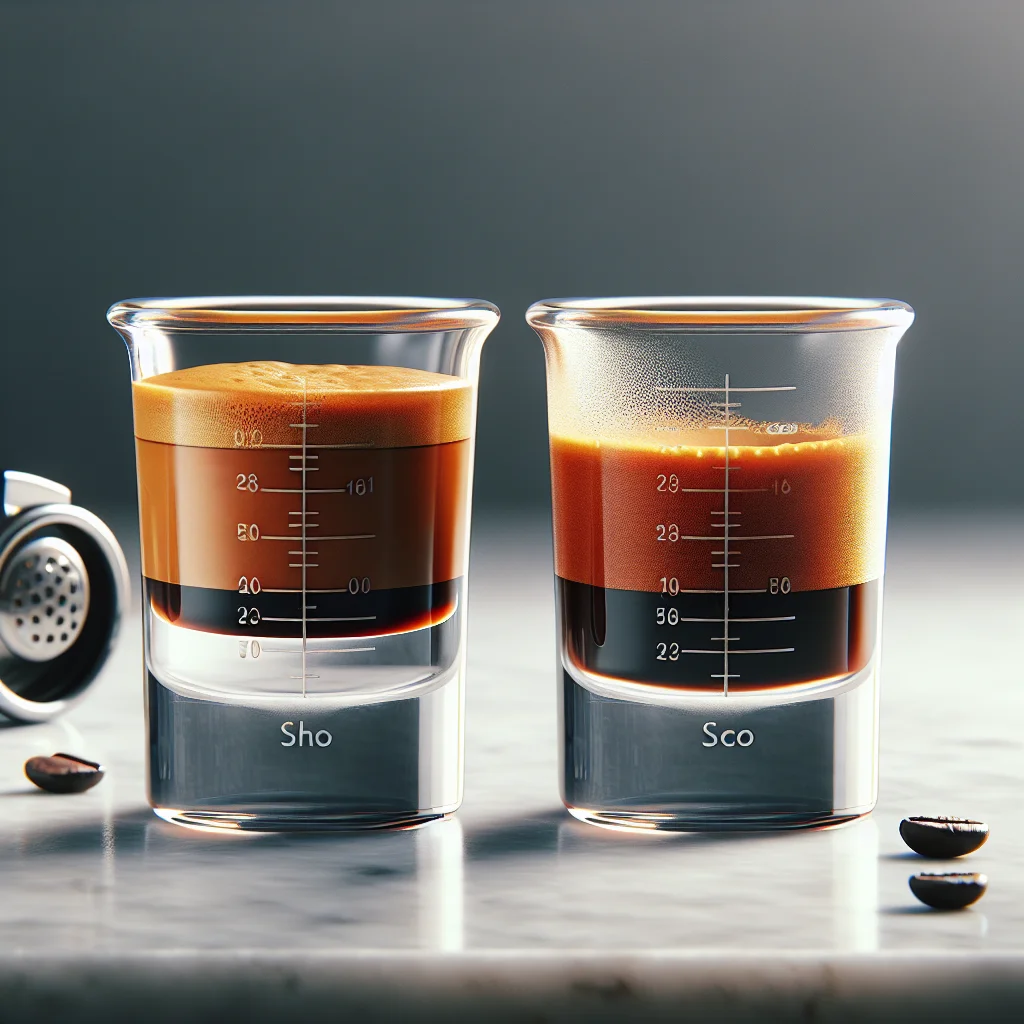
Two dose ranges were compared: a moderate dose (18 g in, targeting 36 g out in approximately 28 seconds) and a higher dose (20 g in, targeting 40 g out in approximately 30 seconds), each with grind size adjusted to keep the brew ratio at 1:2. The higher dose consistently produced a thicker crema layer — measured by allowing the shot to settle for 15 seconds in a transparent double-wall glass and marking the crema boundary with a dry-erase pen. Average crema depth at the 15-second mark was roughly 4 mm for the 18 g dose and 5.5 mm for the 20 g dose (both using the same single-origin medium roast).
When grind size was made finer within the 18 g dose (pushing extraction time to approximately 34 seconds without changing the dose), crema thickness increased only marginally (to about 4.5 mm), but its colour shifted noticeably darker and its texture appeared denser — more uniform microbubbles, fewer large voids. The result suggests that dose has a larger effect on crema volume than grind adjustment alone, while grind fineness influences crema texture and colour more directly.
Crema Density and Milk Paint Contrast
A thicker crema layer does not automatically improve latte art definition. In pours conducted immediately after extraction (within 10 seconds), the 20 g dose’s thicker crema sometimes caused milk to sit on top rather than integrate smoothly, producing blurred edges on tulip petals. By contrast, the 18 g dose with finer grind — yielding moderate crema thickness but denser, more uniform microfoam-trapping bubbles — provided a surface that accepted milk with cleaner contrast lines.
The mechanism likely involves the crema’s role as a surfactant-rich film. Crema contains melanoidins and lipid-based surface-active compounds that interact with the milk’s own surfactant proteins (primarily caseins and whey proteins, discussed further on the Milk Type Experiments page). When crema is excessively thick but loosely structured, the milk sinks unpredictably through weak spots. A thinner but more cohesive crema layer appears to act as a more consistent substrate — milk spreads laterally on its surface before diffusing downward, which is precisely the behaviour needed for pattern definition.
Timing: How Quickly Crema Degrades
Crema dissipation was tracked by photographing shots at 15, 30, 60, and 90 seconds post-extraction. By 60 seconds, crema depth had fallen by roughly 40–50 % across all doses tested, and colour had lightened from a tawny brown toward pale tan. Pours initiated at the 60-second mark showed measurably lower contrast between the espresso base and steamed milk — the “canvas” was effectively fading. This finding reinforces a practical constraint: the window for optimal latte art begins to narrow significantly after about 30 seconds, regardless of how the shot was pulled.
Practical Takeaways
Across these trials, the combination that produced the most consistently defined latte art was a standard 18 g dose ground slightly finer than the typical extraction target (aiming for 30–32 seconds rather than 26–28), poured within 20 seconds of shot completion. This yielded a crema layer of moderate thickness but high cohesion — enough colour contrast to frame the milk, enough structural integrity to keep patterns sharp.
These findings interact heavily with milk preparation and pour mechanics. Readers interested in how steaming temperature and microfoam density affect the other half of the equation may find the Temperature & Steam Pressure Tests and Pouring Technique Variables pages useful as companion reading.