Pouring Technique Variables
Every latte art pattern is, at its mechanical core, the result of milk meeting espresso under specific physical conditions. The variables most within a barista’s direct control — pour height, flow rate, pitcher angle, and wrist movement — can be isolated and tested with reasonable repeatability, even on a home setup. The experiments described here attempt to do exactly that, holding milk type, temperature, and espresso preparation as constant as possible (whole milk at roughly 62 °C, 18 g in / 36 g out espresso) while changing one pouring parameter at a time.
Pour Height and Surface Penetration
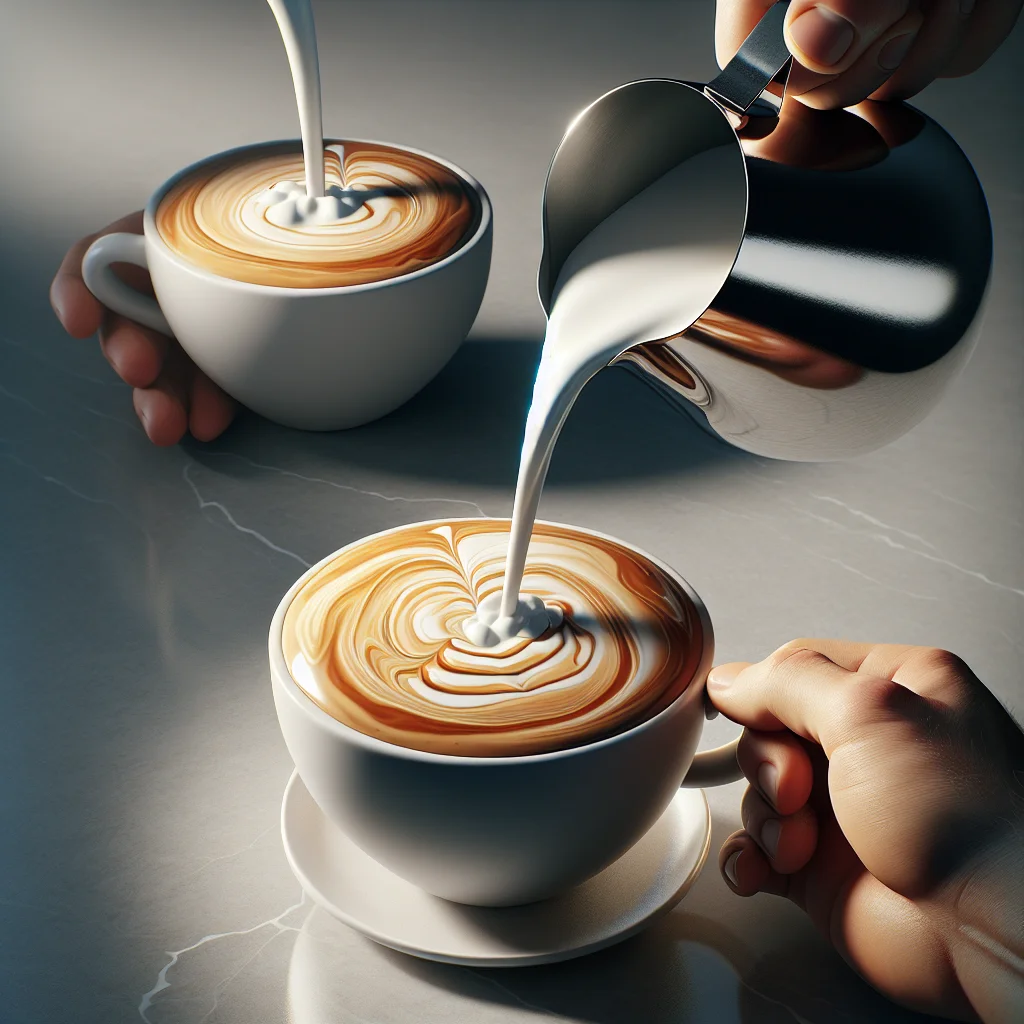
The distance between the pitcher spout and the surface of the espresso drink has a pronounced effect on whether steamed milk sinks beneath the crema or spreads across it. In repeated trials, a pour initiated from approximately 15 cm above the cup resulted in the milk stream penetrating the crema cleanly, mixing into the body of the drink without leaving visible white on the surface. When that height was reduced to roughly 1–2 cm, the milk instead floated across the top, producing the white “canvas” necessary for pattern definition.
The practical implication is straightforward: higher pours are useful for building volume in the cup (the base pour phase), while the shift to a low pour signals the transition into pattern work. What proved less obvious in testing was the sensitivity of that transition zone. A difference of just 3–4 cm near the surface changed whether milk sat on top or dove underneath. This suggests that consistency in dropping the pitcher closer to the cup at the right moment is at least as important as the steady-state height itself.
Flow Rate and Line Definition
Flow rate — the volume of milk leaving the spout per unit time — was adjusted by tilting the pitcher more or less aggressively. A slow, restricted flow (roughly 4–6 mL/s, estimated by timing pours into a graduated cylinder) produced thinner white lines on the surface, useful for detail work in patterns like rosettas. A faster flow (closer to 12–15 mL/s) created broader, more diffuse patches of white, which are characteristic of the initial heart or tulip base layers.
The relationship between flow rate and line sharpness was not perfectly linear. Beyond a certain threshold (approximately 15 mL/s in these tests), the additional volume did not widen lines proportionally but instead caused turbulence that disrupted existing pattern elements. The result suggests that there is a functional upper limit to useful flow rate, beyond which definition degrades rather than scales.
Pitcher Angle and Wrist Oscillation
Pitcher angle affects both flow rate (as noted above) and the directionality of the milk stream. Holding the pitcher at a steeper angle relative to the cup’s surface tended to produce a more concentrated point of contact, while a shallower angle spread the stream slightly. For rosetta patterns, a steeper angle during side-to-side wrist oscillation yielded narrower leaf segments.
The oscillation speed itself proved to be a critical variable. Faster wrist movements (roughly 3–4 oscillations per second) created tighter, more numerous leaf lines in a rosetta, while slower movements (1–2 per second) produced wider, fewer segments. Consistency of oscillation rhythm mattered as much as speed — irregular timing produced visibly uneven spacing between lines. Practising a metronome-like wrist cadence, even away from the machine, appears to be a reliable way to improve symmetry.
Bringing the Variables Together
None of these parameters operates in true isolation during an actual pour. Height, flow rate, angle, and oscillation interact continuously over the roughly 8–12 seconds of a typical pattern pour. What these controlled tests offer is a clearer sense of which variable to adjust when a specific flaw appears — for example, addressing lines that are too thick by reducing flow rate rather than changing oscillation speed.
For context on how milk preparation itself feeds into these results, the findings on the temperature and steam pressure page are directly relevant (microfoam density and viscosity set the stage for how milk behaves during the pour). Readers newer to this approach may also find the beginner’s guide a useful starting framework before diving into single-variable tests.