Beginner's Guide to Experiment-Based Latte Art
Most guides to latte art begin with “pour the milk like this.” That instruction, while not wrong, skips an important question: why does a particular motion, temperature, or milk type produce a specific result? The approach taken throughout this site is to treat each cup as a small experiment — isolating one variable at a time, observing the outcome, and adjusting deliberately rather than randomly. What follows is a framework for adopting that method from your very first pour.
Establishing Your Baseline
Before testing any variable, you need a consistent starting point. A baseline is simply a set of conditions you repeat every time so that when you change one thing (say, pitcher height), you can attribute the difference in outcome to that change rather than to three things shifting at once.
A practical baseline for a home barista might look like this:
- Milk: Full-fat (roughly 3.5 % fat) cow’s milk, refrigerated to approximately 4 °C before steaming
- Steam pressure: Whatever your machine produces at its default boiler setting (note the gauge reading or, if ungauged, the approximate time to reach target temperature)
- Target milk temperature: 60–65 °C (measured with an instant-read thermometer clipped to the pitcher)
- Espresso dose and yield: A fixed ratio — for instance, 18 g in, 36 g out, in roughly 28 seconds
- Cup: The same vessel every time, since cup diameter and depth influence how patterns form
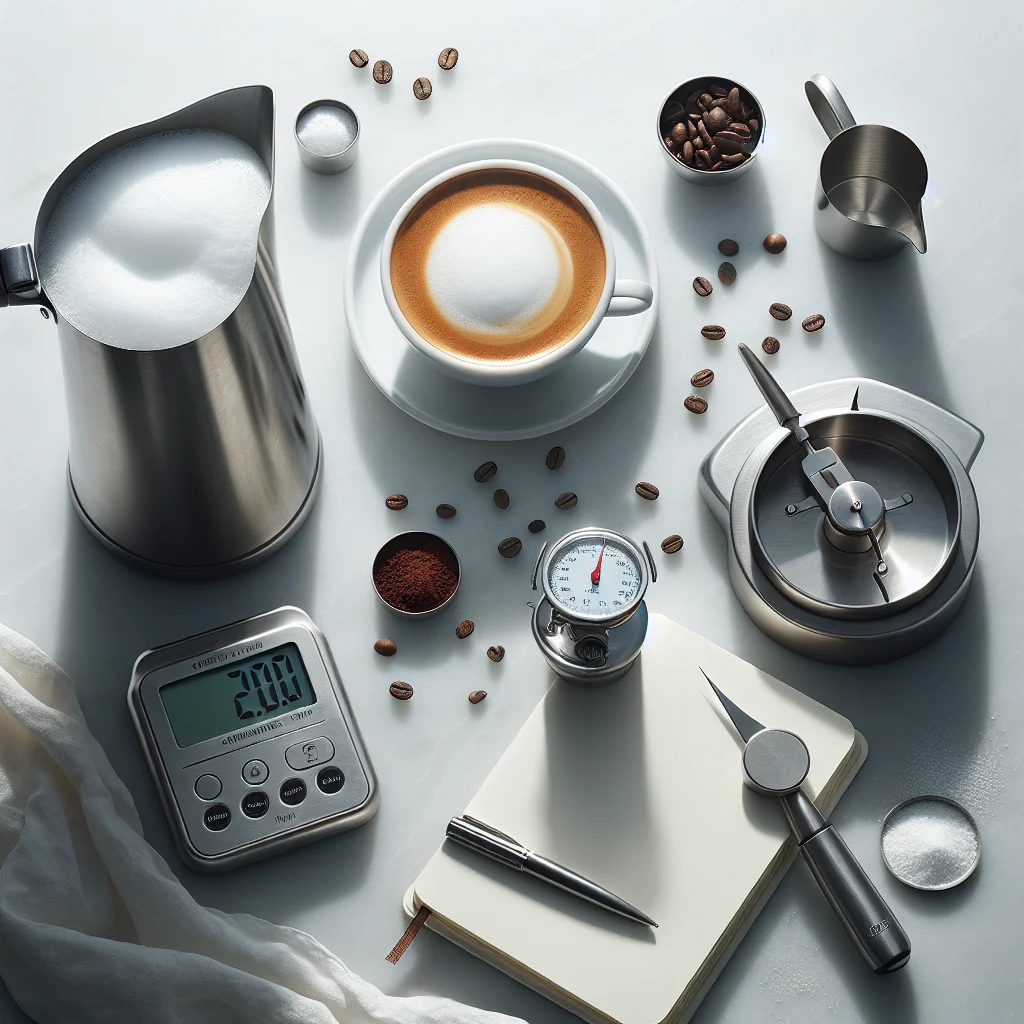
Write these numbers down. A small notebook or a simple spreadsheet works well. The specific values matter less than their consistency; the goal is repeatability, not perfection on day one.
Isolating a Single Variable
Once your baseline feels comfortable (most people need five to ten repetitions before the process becomes somewhat automatic), choose one variable to adjust. Only one. This constraint is the core discipline of the method, and it is where most self-taught baristas diverge from a structured approach.
Good first variables to test include:
- Milk temperature — try three pours at 55 °C, three at 62 °C, and three at 70 °C, keeping everything else constant. Observe how microfoam density (the weight and texture of the foam layer) and flow behaviour change.
- Pitcher height above the cup — pour from roughly 1 cm above the surface versus 4–6 cm, and note the difference in how the milk submerges beneath the crema or sits on top.
- Pour flow rate — a slow, narrow stream compared with a wider, faster one, holding pitcher height steady.
After each set of pours, record what you see: contrast between white and brown, symmetry of any pattern, texture of the foam on the surface. Photographs taken from a consistent angle (directly overhead is easiest to compare) are more useful than memory.
Reading Your Results
A single pour tells you very little; a series of pours under controlled conditions begins to tell a story. When you notice, for instance, that milk steamed to 55 °C consistently produces a thinner, more fluid microfoam that sinks more readily, the result suggests that lower temperatures preserve less stable foam structure (a phenomenon related to the behaviour of whey proteins as surfactants — see the Glossary for more on surfactant proteins). You are not guessing; you are observing a pattern across multiple trials.
Not every experiment will yield a clear conclusion. Sometimes the variable you chose has a smaller effect than you expected, or your baseline drifted without you noticing (a common issue when steam boiler pressure fluctuates between shots). Recording “inconclusive” is a perfectly valid finding — it narrows the search.
Where to Go from Here
This framework scales naturally. Once you are comfortable isolating one variable, you can explore the more specific experiments documented across this site: comparative tests of different milk types, the relationship between steam pressure and foam structure, and the mechanics of pour technique. The Equipment & Tools Reference covers the instruments (thermometers, scales, pitchers) that make consistent measurement practical. Each page follows the same logic outlined here — baseline, isolation, observation, conclusion — applied to a narrower question. The method is straightforward, if occasionally tedious; the reward is that improvements, when they come, are understood rather than accidental.