Glossary of Latte Art & Milk Science Terms
This reference collects the working definitions used throughout the experiments and guides on this site. Where a term has multiple meanings in broader food science or coffee culture, the definition here reflects the specific sense in which it appears in our latte art context. Terms are grouped by category rather than listed alphabetically, since many concepts are easier to grasp when placed alongside related ideas.
Milk Foam & Texture Terms
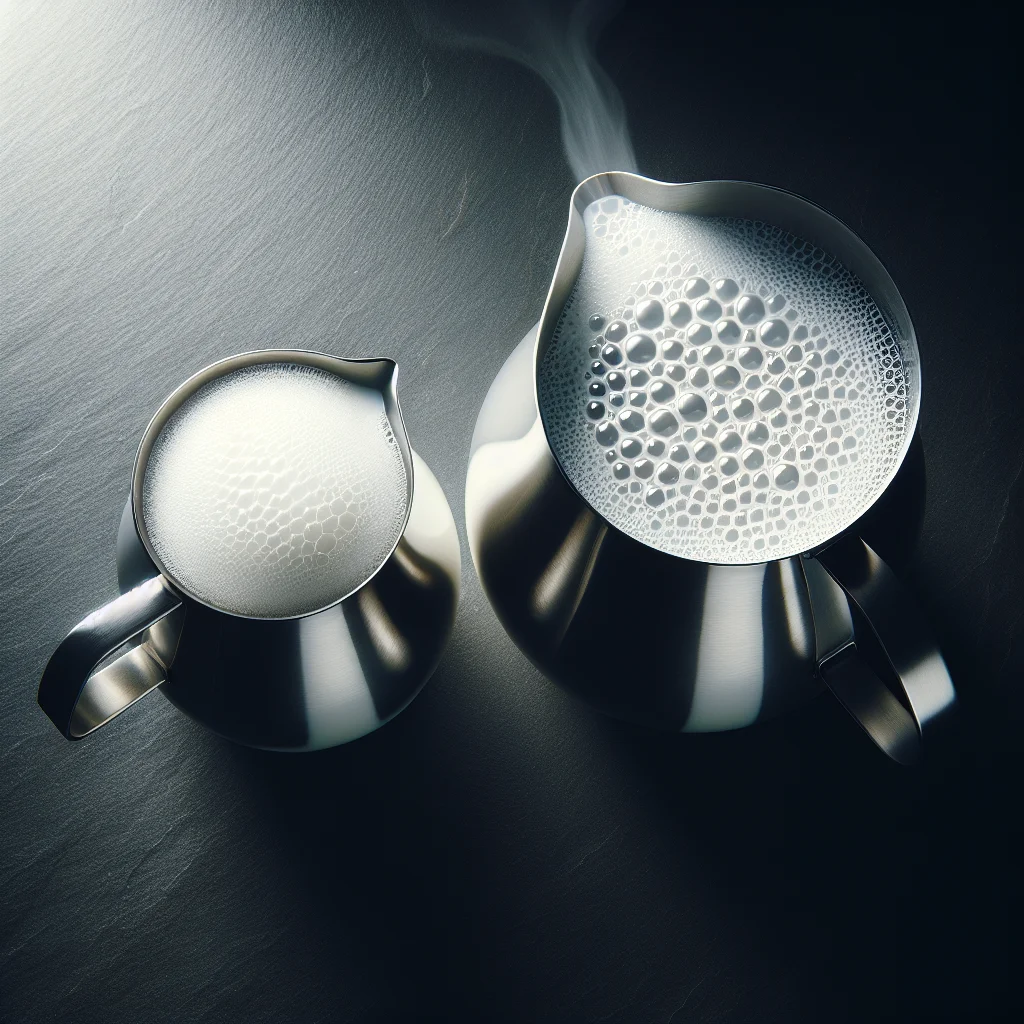
- Microfoam — Steamed milk in which the bubbles are uniformly small (generally under 0.5 mm in diameter), producing a glossy, paint-like texture. Microfoam is the primary medium for latte art; its density and consistency determine how well poured patterns hold their shape. (For a deeper look at how different milks produce different microfoam qualities, see the Milk Type Experiments.)
- Macrofoam — Larger, visible bubbles (often several millimetres across) that sit on top of steamed milk. Macrofoam is generally considered undesirable for latte art because it breaks pattern definition and produces an uneven surface.
- Microfoam density — A rough measure of how much air is incorporated per unit volume of steamed milk. Higher density foam holds patterns longer but can be more difficult to integrate during the pour. Lower density foam flows more freely but tends to produce less contrast.
- Surfactant proteins — Proteins in milk (primarily caseins and whey proteins) that migrate to the surface of air bubbles during steaming, stabilising them. When these proteins denature — that is, when their molecular structure unfolds due to heat — they form a more rigid film around each bubble, which is one reason foam stability changes with temperature.
- Protein denaturation — The structural unfolding of milk proteins caused by heat. The result is increased foam stability up to a point (roughly 65–70 °C, measured at the pitcher wall with an instant-read thermometer), beyond which proteins aggregate excessively and foam quality degrades. This threshold is explored in detail on the Temperature & Steam Pressure Tests page.
- Stretching — The initial phase of milk steaming in which the steam wand tip sits just below the surface, drawing air into the milk. The duration of stretching largely determines final foam volume.
- Texturing (or rolling) — The phase following stretching, in which the steam wand is positioned deeper in the pitcher to create a vortex that breaks large bubbles into smaller ones and distributes foam evenly throughout the milk.
Pouring & Pattern Terms
- Free pour — A latte art technique in which patterns are created solely by manipulating the pitcher’s position, angle, height, and flow rate during the pour — without the use of etching tools. The variables involved are examined on the Pouring Technique Variables page.
- Flow rate — The volume of milk leaving the pitcher per unit time. Flow rate is controlled by wrist angle and pitcher tilt; faster flow tends to push foam forward on the surface, while slower flow allows it to land more precisely.
- Contrast — The visual distinction between the white of the milk foam and the brown of the espresso crema or coffee surface beneath it. Higher contrast generally indicates well-textured foam poured onto a stable crema base.
- Rosetta — A leaf-shaped pattern created by oscillating the pitcher side to side while moving it backward across the cup, then cutting through the centre with a thin stream. It is one of the most common benchmarks for free-pour proficiency.
- Monk’s head (or tulip) — A pattern formed by pouring discrete rounds of foam that stack into layered shapes. Each push of milk partially submerges the previous layer, creating a nested effect.
Espresso & Base Terms
- Crema — The thin, tawny-coloured emulsion of oils, CO₂, and fine coffee solids that forms on top of a freshly extracted espresso shot. Crema provides the contrasting canvas for latte art and its stability affects how long patterns remain defined. (More on this topic can be found at Espresso Base & Crema Analysis.)
- Channeling — Uneven water flow through the espresso puck, resulting in inconsistent extraction and often a thinner, less stable crema.
This glossary is a living reference designed to support the experiments and guides elsewhere on the site. For an introduction to how these terms connect in practice, the Beginner’s Guide to Experiment-Based Latte Art provides a useful starting framework, while the Equipment & Tools Reference covers the physical instruments mentioned throughout.